by Greg Bruno | September 20, 2024
-
News & Updates
News
January 23, 2020
Guide to Live Blogging: Everything you need to know
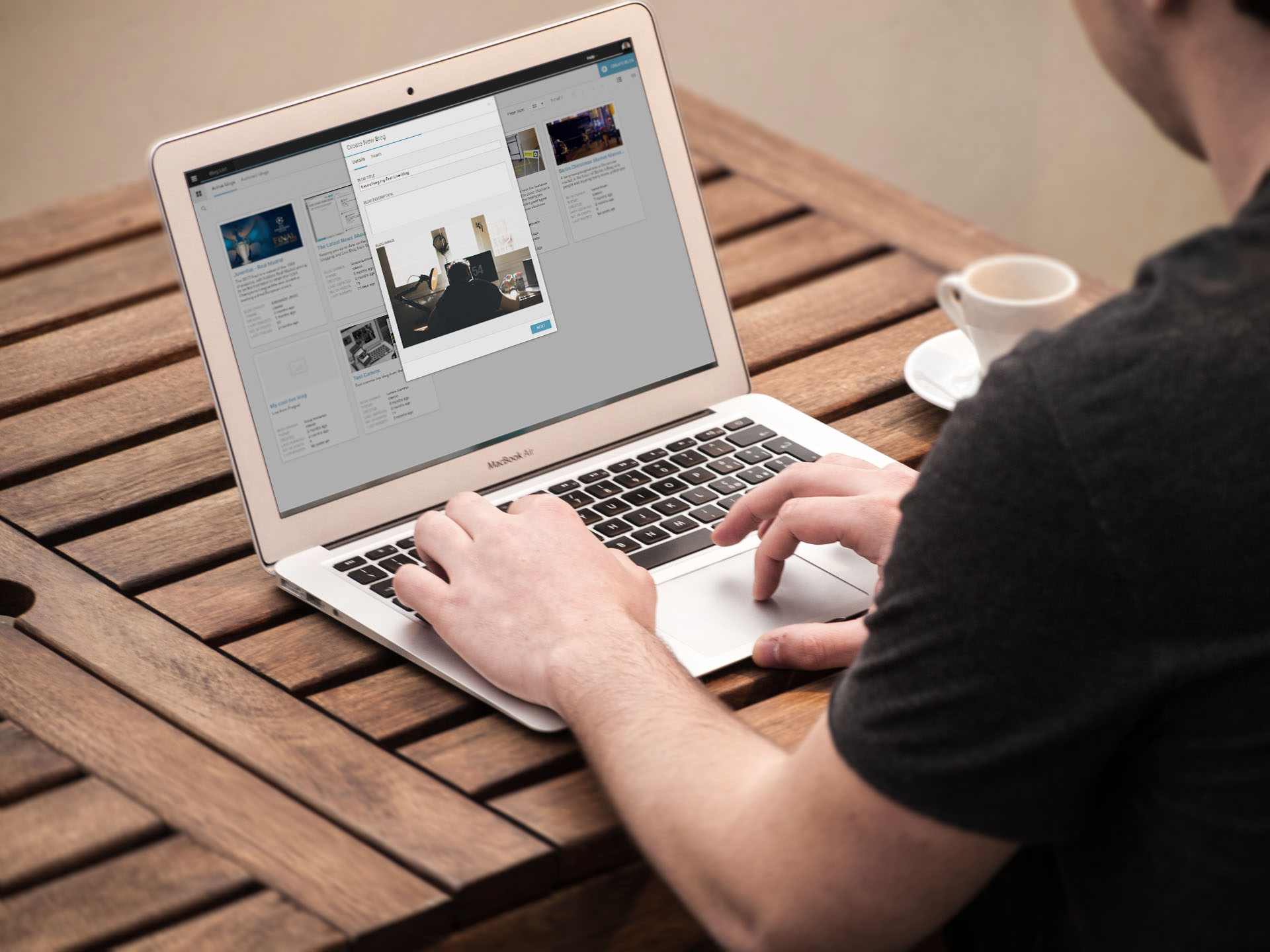
Guide to Live Blogging: Everything you need to know
In today’s news cycle, there’s no time for down time: live blogs are one of the best ways to deliver information quickly. But what, exactly, is live blogging, and what are live blogs good for, and which live blogging tool should you use? Good questions; here are some answers.
What is a live blog, anyway?
A live blog, sometimes referred to as “live text,” is a blog post that provides a rolling textual coverage of an ongoing event supplemented with images, videos, and other digital material. According to The Guardian: “Live blogs provide commentary and analysis alongside breaking news rather than summarising the event after it is over. It’s a transparent format in which the writers are able to update and amend their commentaries in easily digestible paragraphs.”
Live blogging can be used for a wide variety of events and circumstances – such as sporting events, elections, concerts, award ceremonies and conferences. Although live blogs are constantly evolving, news organisations use live blogs for a number of reasons: to reach wider audiences, to increase the transparency of the traditional news-making process, to increase content engagement, and even to generate new streams of revenue through blog syndication.
Live blogging through the ages
What started in the mid-2000s as a software tool for techies to broadcast technology conferences has since become an essential story format for journalists and other information providers to distribute digital coverage in chronological order.
Personalisation is a live blog’s comparative advantage. Unlike television, which must be watched in a linear way and in real time (although viewers can record it and watch it later), live blogs allow readers to start at any point in the story and reread, save, share, and digest information at their own pace.
Why live blogging?
Live blogs are widely read. In 2012, research by City University London found that live blogs get 300% more views and 233% more visitors than conventional online articles on the same subject. Live blogs also outperform online picture galleries, getting 219% more visitors. In 2013, the Reuters Institute for the Study of Journalism found that readers increasingly prefer live blogs to static content and believe live coverage to be more balanced and neutral. Additionally, 62% of survey takers said live blogs are the best format to consume news at work.
More recent data shows that audiences are spending less time reading full news stories and more time engaging with highlights and breaking news – everything from Steph Curry’s three-point buzzer beater to coverage of natural disasters. In fact, when big news breaks, studies show that readers actively seek out quality information through online search – before content is shared on social media. That’s one reason why having a live blog dedicated to breaking news coverage will boost your site’s profile online.
But the benefits are not limited to the immediate time during and after an event. It turns out that readers go back, again and again, to visit live blog timelines of events in the past. “Our experience is that live blogs drive lots of traffic to our site,” said Sybille Klormann, an editor at Zeit Online covering politics and economics. “We are often surprised at how many people visit these blogs, especially during elections, but also show a continued interest afterwards.”
Bottom line: “Live blogging can be a very valuable resource to your readers if done right,” says professional blogger Cameron Chapman. “If you take the time and keep focused throughout an event to provide useful information to your readers, they’ll often consider your blog the go-to place for event coverage in your industry. If it’s done poorly, though, all those blog posts will likely just be looked at as filler or fluff by your readers, and may even annoy some to the point they unsubscribe from your RSS feed.”
Proven use cases for live liveblogging
Live blogs can be used for covering a wide-array of news stories and banner events – as breaking news, elections, esports, conferences, award shows, and live sports. But even the most niche topics can find an audience with a well-done live blog.
Aleks Vickovich, wealth and legal managing editor at Momentum Media in Australia, says one company publication, ifa (Independent Financial Adviser) used a live blog to cover two weeks of financial hearings in 2018. As a result, ifa saw its new traffic increase by 200%. For a publication with “an extremely niche audience of hard core fans,” Vickovich said the growth made possible with live blog was staggering. “We had something like 60,000 unique visits in the two-week period, which is about twice what we usually get in a month.”
Part of that success is because live blog content is becoming more visible in web searches. Why does this matter? Because when the text of a live blog post appears as native content to search engines, it raises the profile of that news organisation’s coverage in new web searches, and also helps with the site’s overall SEO (search engine optimisation). Live blogs provide fresh, relevant content and increase engagement – essentially, longer session durations – through real-time updates, both of which are important factors in enhancing a website’s search rankings. Additionally, integrating LiveBlogPosting schema can improve a live blog’s visibility by indicating that an article is connected to a live event, helping it stand out in search results.
How to live blog successfully
The Internet is full of tips on how to live blog properly, and it can be a challenge to cut through the digital noise. To help you make the most out of your live blogging activity, we’ve collated some of the best insights from across the industry:
Step #1 | Choose the right live blog software
First you need to pick a live blogging platform that serves your needs. Sourcefabric’s Live Blog is a powerful, professional open-source live blogging tool created for journalists and bloggers on the go. It includes rich media posts – like image slideshows and video streams – as well as custom post types and scorecards for covering sporting events.
Additionally, Live Blog offers easy ways to monetise your coverage with tools to integrate native or remote ads into your live blog’s timeline.
The platform also offers a mobile reporting app (Live Blog Reporter) that allows your live blog team to contribute directly from their mobile phones. The app is particularly useful for events such as protests, concerts, and music festivals, where reporters need to write their live blog on the go, unencumbered by bulky equipment.
Step #2 | Plan your coverage BEFORE you start blogging
Once you’ve got your live blogging software picked out, now you need to think deeply about your topic and your blogging strategy. Start by identifying topics that your audience cares about. Whether it’s an important political debate, a major sports match, or a significant cultural event, choose live blogging topics that align with your readers’ passions and interests. After selecting your topic, develop a strategic approach. Coming up with material ad hoc is not the best practice for maintaining a successful live blog. Even though events unfolding in real time often leave little to no opportunity to prepare, there will inevitably be in-between moments where not much is happening. During these times, it’s important for you to have relevant material prepared in advance, general knowledge on the topic you’re covering, and reliable contacts who can assist you.
Step #3 | Think in terms of editorial resources
Producing a good live blog requires people. Some practical questions to consider: is there enough staff available at that particular moment and are there reporters on the scene able to provide information, verify facts, as well as submit images and videos? If the answer is no, perhaps a live blog isn’t the correct format.
Step #4 | Build in communication and collaboration tools
Using established lines of communication is essential for a time-sensitive format like live blogging. If you have a team of more than one, how will you share information about the blog’s content? Whether it’s a tool like Slack or email, you’ll need a way to exchange ideas and content before it’s posted.
Step #5 | Experiment
Because news consumers have taken a much greater interest in live blogs, the go-to form of storytelling offers endless opportunities for innovating. New organisations use live blogging for boosting audience engagement, increasing transparency in the news-production process, and even to generate revenue. There’s really no end to how a live blog can be deployed.
Live Blog examples
Below you will find a variety of live blog examples from around the web that best illustrate the potential of the format.
Der Tagesspiegel has been using Live Blog to provide continuous real-time updates on the Russia-Ukraine war. Their live coverage keeps audiences informed on breaking news with minute-by-minute developments throughout the conflict, such as military operations, reactions from global readers, and interactive maps.
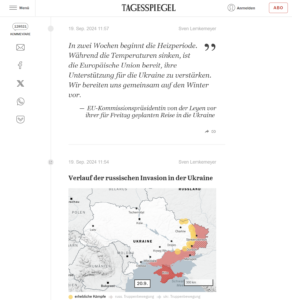
Tagesspiegel implemented Live Blog for real-time insights on the Russia-Ukraine war
Danmarks Idrætsforbund (the National Olympic Committee and Sports Confederation of Denmark) used Live Blog for the Paralympics to deliver real-time reporting of the event. They included a variety of social media content to make their coverage more visual and interactive for readers.

Danmarks Idrætsforbund used Live Blog for their Paralympics’ coverage
The Eurovision Song Contest used the Live Blog platform in the past to manage their live updates, incorporating social media and different forms of multimedia into Eurovision’s overall branding and corporate identity. The live blogging software efficiently handled tens of thousands of concurrent users, allowing the organisers to share highlights of the events and behind-the-scenes content without any technical issues.
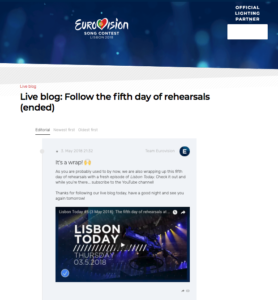
The Eurovision Song Contest’s live blog complemented their branding nicely
The M100 Sanssouci Colloquium is an international media conference held every year in Potsdam, bringing together representatives from traditional, independent, democratic media, alongside voices from politics and science, to discuss current socio-political developments and the media’s role in international affairs. They used Live Blog to provide real-time coverage of the conference, improving discussion and engagement by allowing digital participation and highlighting speaker quotes. The live blogging platform created an accessible, interactive experience for both online and on-site attendees.
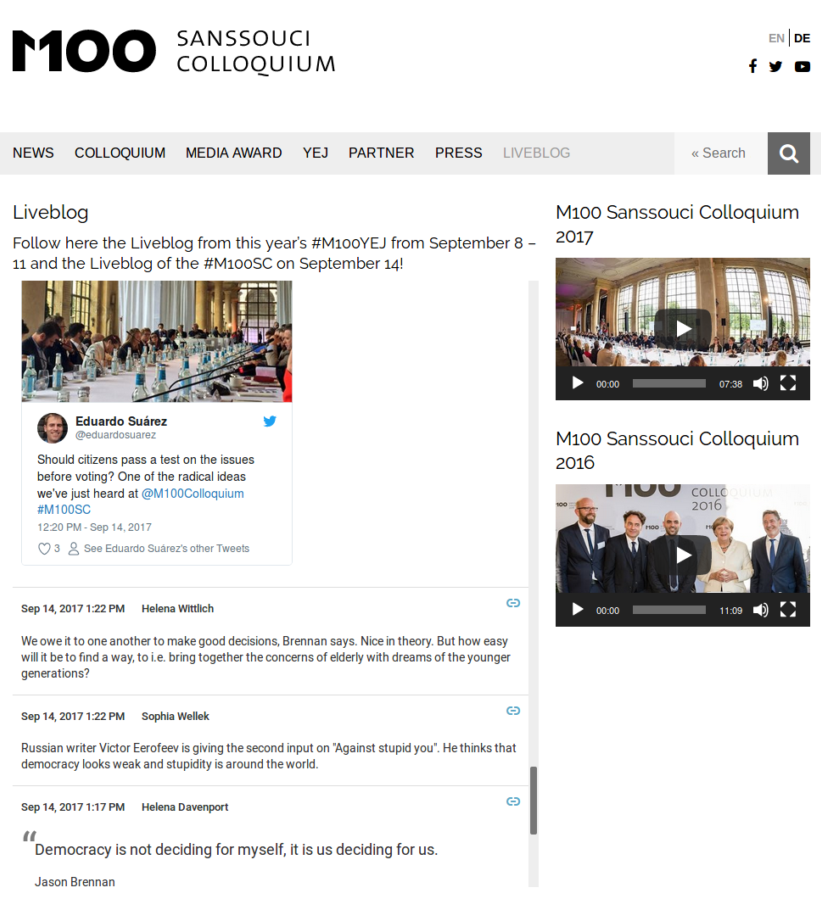
M100 Sanssouci Colloquium used Live Blog for their conference
Frequently asked questions about live blogging
How do I decide what to live blog about?
Select topics that happen in real-time and are of high interest, such as major sports or music events or breaking news. Watch out for trending topics and choose something relevant to your audience.
What makes a good live blog?
A good live blog provides timely updates, accurate and relevant information, and engaging content that keeps readers coming back. Consistent updates and interactive elements, such as polls or a comment section, can improve the overall experience.
How profitable are live blogs?
Live blogs can be profitable depending on different factors such as traffic volume and a good monetisation strategy. Revenue can come from native or remote ads, sponsorships, and premium content.
What are the best topics for live blogging?
Popular topics for live blogging include sports, such as the NBA or the Champions League, major news events, and notable entertainment events like the Oscars or the Eurovision Song Contest. Choose a niche with a broad fanbase and audience. Timeliness and relevance are key.
For Live Blog tutorials, check out our YouTube channel or our blog.
Editor’s note: This post was originally published in 2020 and has been updated in 2024 to include new, relevant insights and information.
January 20, 2020
Mobile Blogging with the Live Blog Reporter App

Mobile Blogging with the Live Blog Reporter App
by Greg Bruno | Jan 20, 2020
In the modern media landscape, audiences expect news when it happens. Live blogs are one of the fastest ways to deliver it, and with our mobile blogging tool, updating readers has never been easier.
In this post (and in the video below) we’re going to demonstrate how to set up and use the Live Blog Reporter App, which gives your blog writers the ability to write and file from anywhere.
We recently tested the app at a pro-democracy protest in Prague to show you how convenient mobile live blogging can be.
1st Step: Install the Reporter App
The first step is to install the Reporter App on the mobile device you want to work from. Search for “Live Blog Reporter” in the iOS or Google Play app stores. Once you’ve got the app on your device, make sure you’re registered as a user and team member for the Live Blog you want to work on. And, if you need a Live Blog instance, visit liveblog.pro to try Live Blog for free.
Once your account is up and running, the next step is to log into the app. On the app’s home screen enter the URL of your Live Blog instance, your username, and your password. Now, locate the blog you want to work on from your organisation’s Blog List. You can only work on blog’s that are bolded; if a name is greyed out it means you don’t have access.
For this tutorial we’ll walk you through how to post images and videos shot from your device to your Live Blog timeline. We’re using images and videos that we took at a huge protest in Prague’s Letna Park in November 2019.
Step 2: Upload an image along with text
When you log into your Live Blog, you’ll be directed to the Editor pane by default. To post an image along with our text, click the “Image” icon on the app’s menu bar. Then select an image from your device’s gallery. Add a description and author information. Finally, save your work by clicking the “check mark” in the upper right-hand corner of the Editor window.
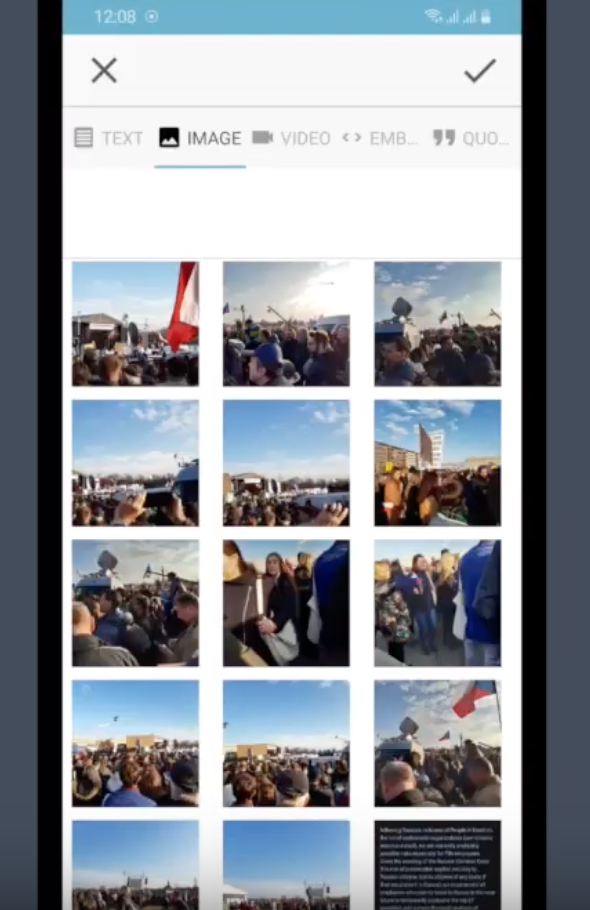
Adding an image
Step 3: Add additional elements
If you want to add additional elements to the post – whether it’s text, images, or videos – click the “plus” sign below the image you just upload.
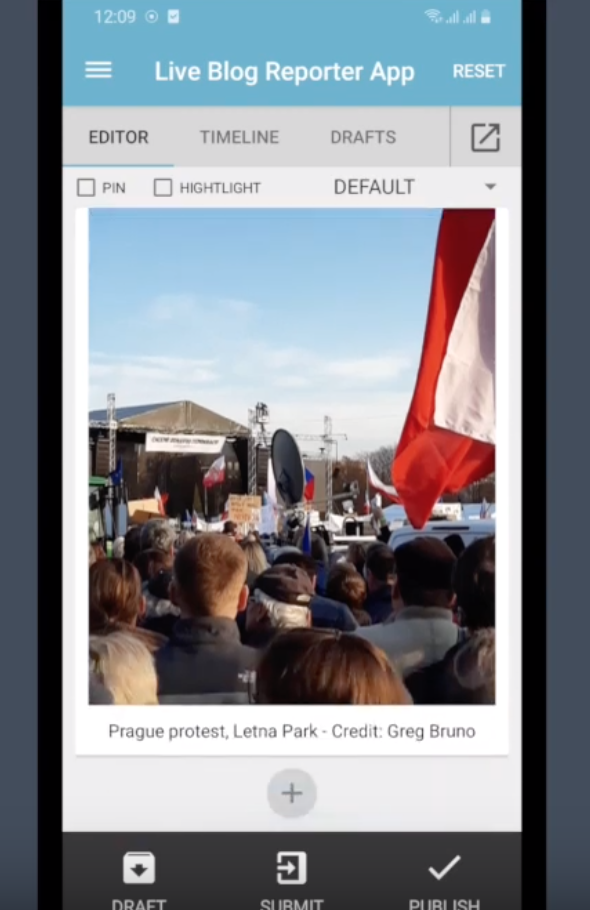
Adding additional elements
Once you’re happy with your post, you can either save it as a “Draft” – a helpful option if you are in an area with weak Internet connectivity – “Submit” it for editorial approval based on your organisation’s workflow, or “Publish” it directly to your Live Blog’s timeline. To see your post in its published form, click the “Timeline” tab at the top of the app. Or visit your blog on the Web.
You can also “Delete,” “Unpublish” or “Edit” a post simply by clicking on it from the “Timeline” view within the App.
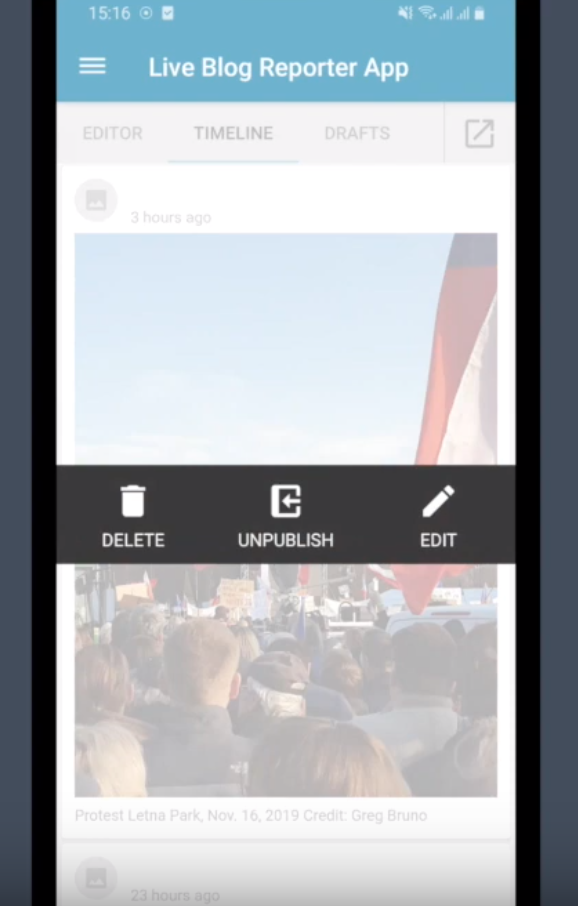
Delete, unpublish or edit
And there you have it. Live blogging on the go is as easy as it’s ever been with the Live Blog Reporter App. For more Live Blog tutorials, check out our YouTube channel or visit us at liveblog.pro.
December 19, 2019
Introducing Live Blog 3.7

Introducing Live Blog 3.7
by Todd Jatras | December 17, 2019
With the release of version 3.7, Live Blog users now have greater control over the management of their content: how they track, syndicate, and even delete it. Ease of use and seamless integration with newsroom workflows has never been better with the industry’s leading live blogging platform.
Live Blog’s new tagging functionality allows editors to apply single or multiple tags to a blog post and filter content based on those tags. Creating syndication models and output channels with new this new feature makes it easier than ever to identify and share blogs between news organisations.
If you’ve ever hit the delete button and immediately regretted it, you need no longer worry about accidentally losing content. Deleted blogs will no longer vanish instantly, but will stay in the “trash” for three days by default.
Live Blog 3.7 also features a new Global Settings section where you can conveniently manage all Live Blog general configurations. We’ve implemented a new setting that allows you to adjust the default privacy status for YouTube video uploads, and that can be conveniently accessed here.
To see the full rundown of 3.7 features, as well as a complete list of bug fixes and performance improvements for this release, visit Live Blog on GitHub. If you have any questions about the latest updates to Live Blog, contact us: saas@liveblog.pro
October 9, 2019
Win More Readers with Custom Posts for Covering Sports

Win More Readers with Custom Posts for Covering Sports
by Todd Jatras | October 8, 2019
All good journalism answers the 5 Ws: who, what, where, when and why. When it comes to covering sports, “how much?” or “how many?” is the other big question that preoccupies fans. Your live blog can cover all the bases: helping fans keep track of their favourite players on and off the field, along with the points they score in the game.
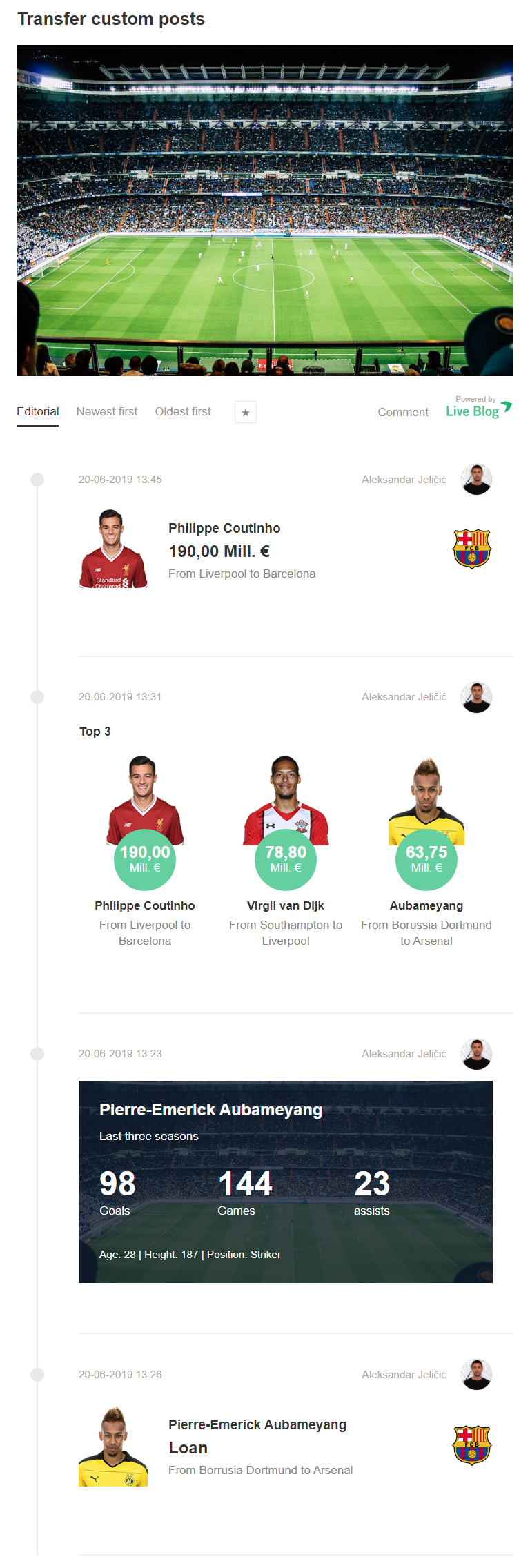
We recently enhanced Live Blog’s coverage options for sports with custom posts to report on football player transfers, as well as the score in tennis matches.
The two main transfer windows during the year for European football, at the start of the year and again in summer, are ideal times to start a live blog for player trades. You can also get creative and use Live Blog for a variety of other real-time updates on matches, players and league standings.
For tennis matches, we have a new custom post that highlights the players in the match as well as letting you update the score in real time.
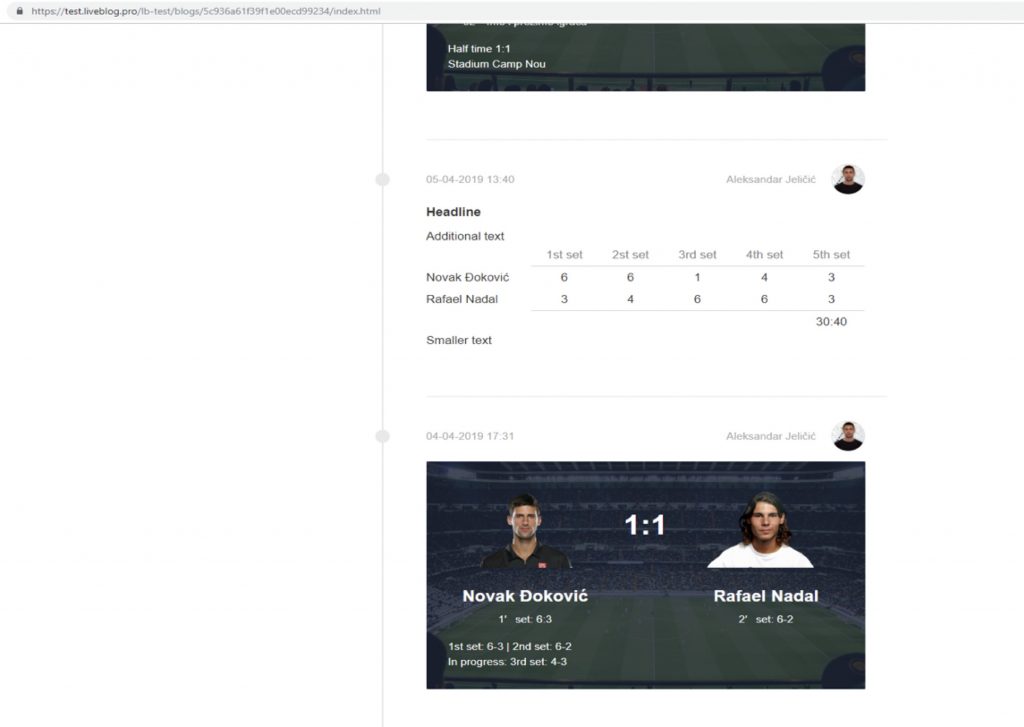
And this is just a sampling of the creative options available for covering sports. Another possibility, if you cover the American sports leagues, would be to have a custom post type for the draft season in basketball or American football. (For the technical details of creating your own custom post types, see the documentation on our wiki.)
And for more tips on how to make the best use of Live Blog’s scorecard for any sporting event, you can read this blog post or watch this short video.
August 7, 2019
Key Features of the Live Blog Reporter Mobile App
Key Features of the Live Blog Reporter Mobile App
by Todd Jatras | Aug 7, 2019
Today’s journalists are on the move more than ever and require as much flexibility as possible in publishing their coverage of live news events. That’s why we’ve updated our Live Blog Reporter app with new features designed to enhance the blogging experience, and for greater integration with newsroom workflows.
If you’re new to Live Blog, you’ll still need to set up your blogging presence on a computer, but after that quick process, most reporting tasks can be handled with ease from a mobile device.
Download the Live Blog Reporter App (newly updated for Android and iOS) onto any connected mobile device and you’ll be able to effortlessly manage, publish and edit all of your blogs while on the go.
Let’s have a look at the great new features:
Reporter now supports direct-to-YouTube video uploads, which will expedite the video-posting process, making videos shot in the field immediately accessible to your whole team.
Another cool feature: posts can be saved as offline drafts and published later, a useful option when working in areas with limited or no internet connectivity. Journalists’ posts can either be published directly or sent to editors for approval.
Additional updates:
- App users can now access their Live Blog timeline to edit existing posts
- Users can pin and highlight posts directly in the app
- A new post type for coverage of sporting events (availability of this feature depends on the user’s subscription plan)
- A faster log-in process. In the past some users had to insert a specialised URL like dpa-api.liveblog.pro in order to log in. Now, after we updated to the new version, this -api was deprecated, and they just need to insert the instance name, i.e dpa.liveblog.pro
May 8, 2019
Ending the Endless Upload: Add Videos to Your Blog Faster with Live Blog 3.6

Ending the Endless Upload: Add Videos to Your Blog Up to 40% Faster with Live Blog 3.6
by Gregory Bruno | May 8, 2019
For many bloggers, video is the pièce de résistance. Competition for eyeballs online is fierce, and relevant video content is often the difference between clicks on your posts or on someone else’s. When slow upload speeds frustrate the proceedings, potential audiences go elsewhere.
Previous versions of Live Blog required users to toggle between metadata, processing steps, and cross-posting. But after much hard work, Live Blog version 3.6 has streamlined this process. With this beta release, direct video uploads to YouTube can now be managed directly from the Live Blog editor, meaning that seconds once lost to agonizingly-slow upload speeds can now be spent actually blogging.
“Videos are among the most popular pieces of content on our clients’ blogs, but until the rollout of 3.6, users needed to juggle two systems to get their videos published. No longer,” said Live Blog product manager Evgeny Deulin. “By enabling direct uploading to YouTube, Live Blog users will see their videos published and viewable faster than ever.”
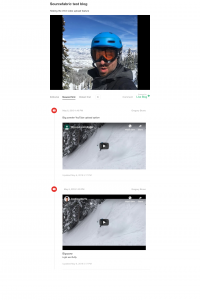 We wanted to quantify just how much extra time this new feature would save bloggers. So, after creating a blog in our in-house testing platform, we hit start on the stopwatch and began uploading a 17 second, 34.5 MB snowboarding video of yours truly (which will remain forever hidden for vanity reasons). In our test it took about two minutes for the full video to process via the new beta uploader, and after attaching a quick headline and description, we were able to share it with colleagues in under three minutes (2:55).
We then compared this with the amount of time spent uploading, tagging, and publishing of the same video to YouTube (with the same stopwatch running), followed by embedding to our Live Blog demo instance. From start to finish, that two-step process took more than five minutes (5:17) to complete. Bottom line: when it comes to publishing videos on your blog, Live Blog 3.6 can slash upload times by more than 40%.
Version 3.6 comes with several additional bug fixes and performance improvements; you can see the full changelog and list of fixes here. We have also prepared a how-to guide on how to connect a Live Blog instance to your YouTube account.
Ready to blog better? Visit Liveblog.pro to sign up for the Live Blog newsletter for all our latest updates, and get in touch with any questions here.
November 7, 2018
Notable Platform for SaaS Reviews Delights Live Blog with 2 Blog Software Titles

Notable Platform for SaaS Reviews Delights Live Blog with 2 Blog Software Titles
by Sarah Wilson | November 6, 2018
With its slick advertising interface, and plenty of features for keeping your feed rich and engaging, we at Sourcefabric believe that Live Blog is the perfect tool for journalists covering live, or ongoing, events. But we’re not the only ones. We’re delighted that FinancesOnline has awarded us with the “Great User Experience” and “Rising Star” certificates in a glowing Live Blog features review published on their site in October.
The review covered several aspects of Live Blog, including benefits like content portability and the software’s optimisation for mobile platforms, allowing journalists to update audiences even while on the go.
Aside from comparing us against the best blog software in the market, FinancesOnline also illustrated the challenges that Live Blog can solve for journalists. This included monetising live blogs, with integration of native remote ads, as well as “slow blogs”; a concept which involves covering a certain topic over a long period of time. DPA, one of our Live Blog customers, has utilised this capability to cover all manner of subjects, from weird, offbeat news stories to the ongoing refugee crisis in Europe.
The review also highlighted Live Blog’s “SEO Default Theme”, a tool that makes the content of your live blog more visible in web searches, therefore bringing extra traffic to your page. Live Blog’s efficiency in improving one’s blog strategies as well as its open-source codebase were a talking point for FinancesOnline, giving journalists all the tools specific and unique to their work while eliminating anything they don’t need.
Overall, the reviewers at FinancesOnline were impressed with Live blog, calling it “fast, intuitive and flexible, letting journalists do their best when they arrive on the scene”. If you’d like to try it out for yourself, head over to our website for a free demo – and get live blogging today.
October 26, 2018
DPA, Hamburger Morgenpost and Live Blog join forces for the ESLOne Hamburg

DPA, Hamburger Morgenpost and Live Blog join forces for the ESLOne Hamburg
by Sarah Wilson | October 25, 2018
You might have watched live football, tennis or rugby. But have you ever been a spectator of e-sport? If not, you’ve got a chance to join 20,000 others this weekend (26th-28th October) who will be tuning into coverage of the ESLOne Hamburg – a Dota2 e-sports championship.
We’re delighted to announce that for this year’s event, Germany’s biggest news agency, DPA, and the Hamburger Morgenpost will be using Live Blog to keep fans engaged with minute-by-minute updates on the tournament.
The popularity of e-sports has been growing over the past few years, with huge events held across the world, from Seoul to L.A. Prize pools for winners reach as high as $18 million, and as video game technology improves year on year, viewing numbers only look set to increase.
The game played varies from tournament to tournament, and at this year’s Hamburg event, players will be battling it out playing Dota2, a multiplayer online battle area in which the aim is for a team to successfully destroy a large structure in the other team’s base camp, known as the “Ancient”.
The Live Blog team have prepared to accommodate traffic from thousands of viewers, and visitors to the feed can expect pictures, videos, social media updates and minute-by-minute commentary on the movement and gains of players in the match. Catch the Live Blog here, with updates starting at 12pm on Friday the 26th of October.
Interested in trying Live Blog for yourself? Sign up for a free demo here.