How to Live Blog the FIFA World Cup: 7 Essential Tips

By Flora Szandi | June 4, 2026

The FIFA World Cup is the biggest sporting event in the world with over 5 billion people expected to tune in across different media. Every four years, demand for real-time, online coverage surges, with billions of fans watching across every time zone.

Live blogging gives audiences a way to follow the action, join the conversation, and experience the atmosphere beyond simply watching on television.

It doesn’t matter if you’re a national broadcaster, an independent football journalist, or a hobbyist sports blogger. A well-executed World Cup live blog can keep your audience glued to your live coverage from the opening whistle to the final goal.

Here are several tips to make the most out of your World Cup coverage.

1. Map Out the Tournament Before It Starts

Group play kicks off on June 11 with the opening match, Mexico vs. South Africa. Before then, lay out a coverage plan for the full six weeks: which group stage matches matter most to your audience, when the knockout rounds fall, and how your live blog coverage will be structured across all of it.

Use that knowledge to prepare draft content for the matches you know are coming. Player profiles, team histories, head-to-head records, key tactical matchups can all be prepared in advance and saved in Live Blog’s drafts feature, ready to publish during quieter moments in a match, at halftime, or just before kick-off when you need something to add for the audience.

Think about the different rhythms of each phase, too: group stages mean multiple matches a day and a high volume of updates; knockout rounds are fewer games but higher stakes and more intense coverage. Plan your workflows around those differences.

2. Keep the Score Front and Centre

At a World Cup, the scoreline is everything. Readers checking in mid-match need to know instantly who is winning, who scored, and in what minute. 

Live Blog’s scorecard feature is purpose-built for this. It lets you display the current score in a visually appealing  way, including goalscorer names and timestamps, and can be updated the moment the ball hits the net. Pin it to the top of your timeline so it’s the first thing any reader sees – whether they’ve been following since kick-off or just arrived.

Highlight the most important posts – goals, red cards, penalty decisions – so they stand out clearly from regular commentary. That way a reader who checks in mid-match can immediately find the key moments without scrolling through everything they missed.
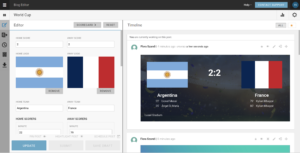
Keep track of the score

3. Engage Your Audience in Real Time

A World Cup live blog isn’t only broadcast; it can be a conversation as well. Use Live Blog’s commenting feature to invite reader participation. Ask questions between updates: Who do they think will score next? Which player has been the best on the pitch?

Polls, predictions, and reader reactions add a layer of engagement that keeps people on your page even during quieter periods. The World Cup is one of those rare events that unites fans across countries, languages, and time zones. Share reactions from fans around the world, pose questions about the match, and let your audience feel part of something bigger.

4. Deliver Timely Match Commentary

During the game, accuracy and speed are everything. Deliver play-by-play commentary that tracks goals, cards, penalties, substitutions, and key chances. Readers who can’t watch the match are relying on you to paint the picture, so be as specific as possible. Think, “Mbappé scores at minute 52 after receiving a perfectly timed pass and finishing into the bottom corner.”

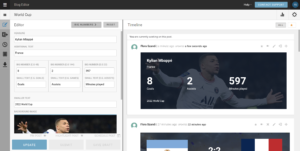
The World Cup also demands that you track metrics beyond the scoreline: possession percentages, shots on target, corner kicks, fouls, and bookings all give readers a richer sense of how the game is being played. Use Live Blog’s statistics and big numbers feature to display these visually rather than burying them in text. Fans expect you to speak their language, so use the correct football terminology and be precise about formations, positions, and tactical shifts.

Show player statistics

5. Tell the Stories Behind the Players

One of the 2026 World Cup tournament’s most promising young stars is Spain’s Lamine Yamal. His breakthrough was at the Euro 2024, when he became the youngest player ever to appear in a European Championship final. Since then, he has won two La Liga titles and two Laureus awards, and is widely considered one of the best players in the world. This World Cup will be his first, and it could define a generation of Spanish football.

Stories like Yamal’s are what your readers connect with on a personal level. In-depth profiles that explore a player’s career, their journey to the tournament, and what this moment means for them add a dimension to your coverage that pure match commentary never can. Draft these in advance and post them into your live blog during natural breaks: halftime, before the starting lineups are announced, or in the minutes after the final whistle.

6. Bring Your Coverage to Life with Multimedia

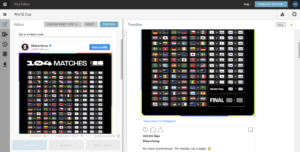
Embed social media posts from players, managers, and fan accounts. Include video clips of key moments where available. Use images from the stadium to give your coverage atmosphere. A live blog that mixes commentary with rich media is far more compelling than a wall of text.

Keep an eye on official team and tournament social media accounts throughout each match. They’re often the fastest source of confirmed statistics, official substitution announcements, and post-goal reactions.

Embed social media posts into your live blog

7. Don’t Forget the Moments Beyond the Matches

The World Cup is about more than 90 minutes of football. The opening ceremony, post-match press conferences, and the closing ceremony are all part of the story. So is the off-pitch drama: injury announcements, surprise results from other groups, managerial reactions, and fan culture from the host cities across the United States, Canada, and Mexico.

Think of the tournament as a continuous narrative with dozens of story threads running simultaneously, not just a series of isolated matches.

Ready to live blog the World Cup?

Get started with Live Blog and deliver real-time coverage that keeps fans engaged from kick-off to the final whistle.